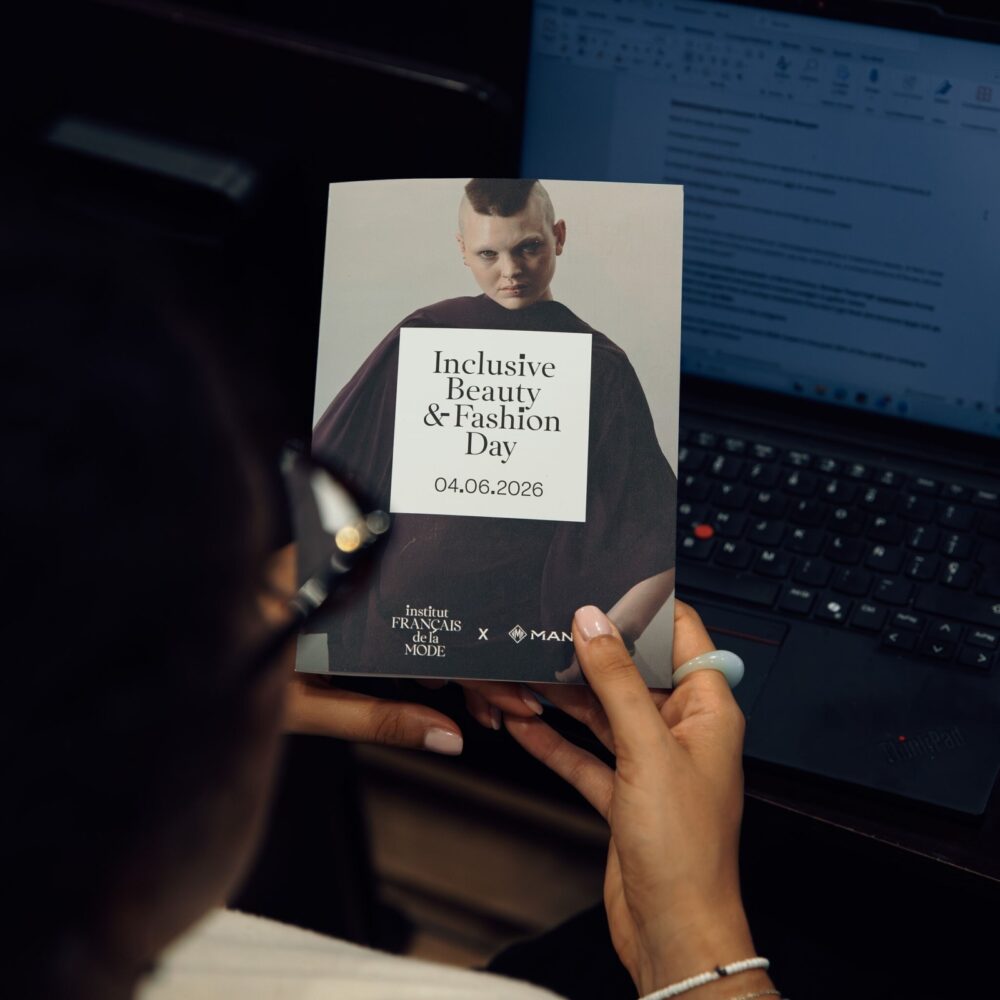
Who Gets to Be Seen? Inclusive Beauty & Fashion Day Returns
On 4 June 2026, the Institut Français de la Mode hosted the second edition of the Inclusive Beauty & Fashion Day, organized by the IFM x MANE Diversity in Beauty Chair. This year’s theme, “The Boundaries of Visibility,” brought together researchers, industry professionals, artists, students, and practitioners to explore a fundamental question: who gets to be seen in beauty and fashion, and under what conditions?
The day opened with welcoming remarks from Xavier Romatet, Dean of IFM, and Professor Alice Audrezet, Head of the IFM x MANE Diversity in Beauty Chair. They were followed by a keynote lecture from Françoise Bouyer, President of PFFT, who examined the current challenges facing Diversity, Equity and Inclusion (DE&I) initiatives. She argued that, at a time when DE&I policies are increasingly contested, practitioners must be willing to critically reflect on their own approaches and develop more mature, effective, and resilient forms of action.
The morning continued with a roundtable discussion entitled “Who Gets to Be Seen? Visibility, Norms and Inclusion,” moderated by Sarah Banon, Professor at IFM. Bringing together Erica Persson (Global Communications Director, BYREDO), Mehdi Khimoum Terki (International Marketing Director, Make Up For Ever), and Ibrahim H. Tarouhit (Casting Director, HYBRA), the panel explored how visibility is shaped through communication strategies, casting decisions, branding practices, and industry standards.
One of the key insights from the discussion concerned the importance of genuine brand commitment. As highlighted by Mehdi Khimoum Terki, in the cosmetics industry, nearly 80% of foundation sales are generated by only a handful of shades. Maintaining an extensive shade range therefore requires more than commercial logic: it reflects a deliberate commitment to inclusion, even when it comes at a financial cost.
The program then turned to the politics of visibility through a range of lived experiences and social realities. Jennifer Takhar, Associate Professor at SKEMA Business School, presented a talk on menopause and visibility, examining the growing cultural attention given to menopause in media, marketing, and popular culture. While menopause has increasingly entered mainstream conversations—through dedicated products, brand initiatives, and cultural references such as Sophie Ellis-Bextor’s Perimenopop album—her presentation invited participants to reflect on the opportunities and limitations of this new visibility.
The conversation then shifted to the relationship between beauty, feminism, and aesthetic medicine. Delphine Saltel, documentary maker and creator of the ARTE Radio podcast Vivons Heureux Avant la Fin du Monde, joined Alice Audrezet for a discussion that avoided simplistic moral judgments. Rather than offering definitive answers, Saltel provided the audience with intellectual tools and cultural references to navigate these tensions.
Drawing notably on film critic Murielle Joudet’s concept of the capital gaze, she suggested that the traditional notion of the male gaze is no longer sufficient to explain the complex relationship many women have with beauty practices. Beyond domination and social norms, the question becomes one of pleasure: where does enjoyment reside? In contemporary capitalist societies, there can be a form of satisfaction in pursuing beauty while simultaneously being aware of the systems of power and inequality that shape those desires.
In the afternoon, discussions turned to hair, recognition, and the experience of being seen. Daphné Bédinadé, doctoral researcher at EHESS, explored the institutional recognition of Afro hairdressing in France and its broader implications for cultural visibility and legitimacy.
The conversation continued with a presentation by IFM students Flore Asselin de Williencourt, Laura Gilibert, Tessa Goldblum, and Capucine Vallier, who shared their research on women’s hair loss and the redefinition of beauty beyond hair. Their presentation was followed by a stand-up talk from comedian and screenwriter Amélie Lémélo, who spoke candidly about her experience with alopecia, visibility, and social perceptions.
Together, these two hair-focused interventions emphasized how unsolicited comments—even when well-intentioned—can become a source of discomfort and stigma. They also pointed to the lack of visibility of intermediate situations, such as patchy hair loss or partial alopecia, which are often among the most difficult conditions to navigate in public spaces. They advocate for more inclusive representations to empower them at every stage of their post-hair aesthetic journey.
The final part of the day broadened the discussion to body diversity and digital beauty. Gaëlle Pantin-Sohier, Full Professor at the University of Angers and President of the French Marketing Association, together with Romain Sohier from EM Normandie Business School, presented their research on consumer responses to inclusive sizing and the challenges brands face when expanding representations of body diversity.
The event concluded with a conversation between Aileen Carville, CEO of Colonii AI, and Alice Audrezet on whether artificial intelligence can redefine contemporary beauty standards. Through the example of Colonii’s digital population—composed of avatars that deliberately move away from idealized beauty norms—the discussion explored how forms of “ugly beauty” can foster stronger emotional connections with human beings.
Across its many sessions, the 2026 edition of the Inclusive Beauty & Fashion Day demonstrated that visibility is never neutral. Visibility can generate recognition, dignity, and empowerment, but it can also expose individuals and communities to stereotyping, simplification, and commodification. The challenge for the beauty and fashion industries is therefore not merely to increase diversity in representation, but to rethink the very conditions under which people become visible—with complexity, respect, and agency.
Through this annual event, the IFM x MANE Diversity in Beauty Chair continues to build a space where academic research, industry practice, creative voices, and student perspectives come together to question and transform the future of beauty and fashion.