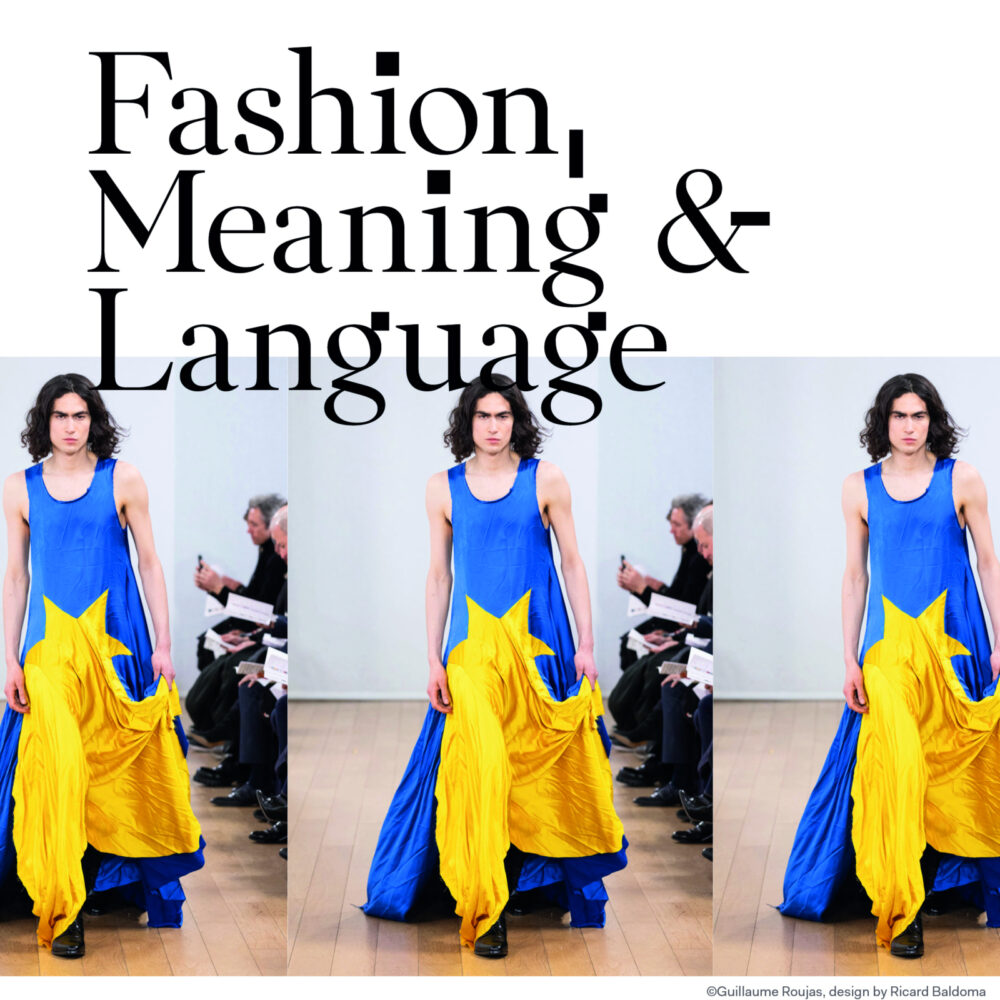
Symposium on Fashion, Meaning and Language on 20 & 21 Nov. 2025
Fashion is a complex visual and material language that creates, transmits, and negotiates meaning across different social contexts. Beyond mere utility or aesthetics, clothing acts as a powerful means of communication—speaking without words, encoding cultural values, social positions, personal identities, and collective aspirations.
This symposium, co-organized by the University of San Diego and Institut Français de la Mode, aims to explore the communicative dimensions of fashion, questioning how clothing acts as a nonverbal language or signalling system.
The theoretical landscape has evolved significantly since Roland Barthes' The Fashion System (1967), which applied the tools of semiotics to fashion. On the one hand, the study of material culture now places greater emphasis on the objects themselves; on the other hand, contemporary linguistic models have moved away from the Saussurean structuralist vision typical of France in the 1960s.
During these two days, international researchers from multiple disciplines (Philosophy, Sociology, Political Science, History, Archaeology, Linguistics...) will share new approaches to the meaning of clothing and fashion. They will introduce concepts and formal tools to build more accurate semantic frameworks, reformulate the research agenda of clothing semantics, and focus on various cases of meaningful dress in different cultural and social contexts.
Program
Thursday, November 20, 2025 — Models of Meaning
→ 9:00 am to 12:30 pm
Introduction by Sarah Banon, Marilynn Johnson and Benjamin Simmenauer
- Benjamin Simmenauer (Institut Français de la Mode) — Dress, Meaning and Signals
- Léo Migotti Ramponi (Institut Français de la Mode) — Ambiguous Clothing: The Meaning of Outfits as a Function of Their Cost
- Alejandro Vesga (University of Houston) — Euphemistic Fashion
- Julian Lee-Sursin (Johns Hopkins University / École Normale Supérieure) — Fashion and the Jacksonian Mode: Intentionality Beyond Language
- Kurt Mertel (American University of Sharjah) — Fashion, Language, and World-Disclosure
→ 2:00 pm to 6:00 pm
- Sanna Hirvonen (University of Lisbon / LanCog) — Sartorial Communication, Aesthetic Communities, and the Common Ground
- Hector Rosas (University of San Diego) — From Wardrobes to Wittgenstein: A Philosophical Exploration into the Language of Bodily Adornment
- Nikita Prokhorov (University of California) — Are You Sure About That Shirt: Wittgensteinian Hinge Certainties and Understanding Mistakes in Fashion
- Laura T. Di Summa (William Paterson University) — An Aesthetics of Touch: Fashion, Emotions, and Embodiment
Friday, November 21 — Practices of Meaning
→ 9:00 am to 1:00 pm
- Francesco d’Errico and Solange Ringaud (University of Bordeaux) — From Pigment to Personhood: The Culturalisation of the Body and the Origins of Fashion
- Marilynn Johnson (University of San Diego) — Fashion Acquisition: The Phenotypic Genesis of Meaning in Childhood
- Laura Cisneros (University of San Francisco School of Law) — Fashion as Judicial Resistance: Gendered Signification in U.S. Supreme Court Attire
- Elizabeth Cantalamessa (St. Bonaventure University) — Adorning Ideology: Fashion, Inference, and the Politics of Meaning
- Jeanne Jacob (Institut Français de la Mode) — Fashion Police – How the Police Uniform Shapes Authority: A Goodmanian Reading of the Police Uniform
→ 2:30 pm to 6:30 pm
- Charlene Gallery, Kevin Harding, and Gavin Douglas (University of Manchester) — Clothing the Resistance: Dress as Epistemic Disobedience and the Challenge of Algorithmic Erasure
- Renée Ramona Robinson (Paris I Panthéon-Sorbonne) — Reimagining Sexy Dressing, Legal Semiotics, and the Cost of Pleasure Through Black Feminist Legal Theory
- Sarah Banon (Institut Français de la Mode) — Talk Dirty to Me: The Language of the Sex Worker’s Wardrobe
- Denis Bonnay (Université Paris Nanterre) — Fashion, Meaning and AI: Can multimodal models read what we wear?
- Christina Pawlowitsch (Université Paris-Panthéon-Assas) — Costly Fashion: A Game Theory Model
- Elisa Palomino (Smithsonian Arctic Studies Center) — Multilingual Narratives: John Galliano’s Sketchbooks and the Hidden Labour of Fashion